 Reviewed by Jane Katkova, Founder & Licensed CICC Consultant
Table of contents9 sections
- Taxes in Panama: A Guide to the Territorial Tax System for Residents and Investors
- The territorial principle: how Panama taxes income
- Personal income tax brackets in Panama
- Estate, wealth, gift and capital gains taxes
- Corporate tax, Law 526 and special regimes
- Consumption tax and property tax
- Residence: the first step to Panama's tax position
- Cross-border compliance: what Panama residence does not change
- Planning your Panama move
For entrepreneurs, investors and families with income in several countries, where you are tax resident matters as much as where you hold your assets. Many high-tax countries are tightening reporting, adding exit taxes and widening worldwide taxation. Panama works differently: it taxes income by where it is earned, not by where you live.
That territorial system, combined with a US dollar economy and a fast residence by investment route, is why Panama appears on the shortlist of many US and Canadian clients. This guide explains how Panama taxes residents, what it does not tax, and where your home country still has a claim.
The territorial principle: how Panama taxes income
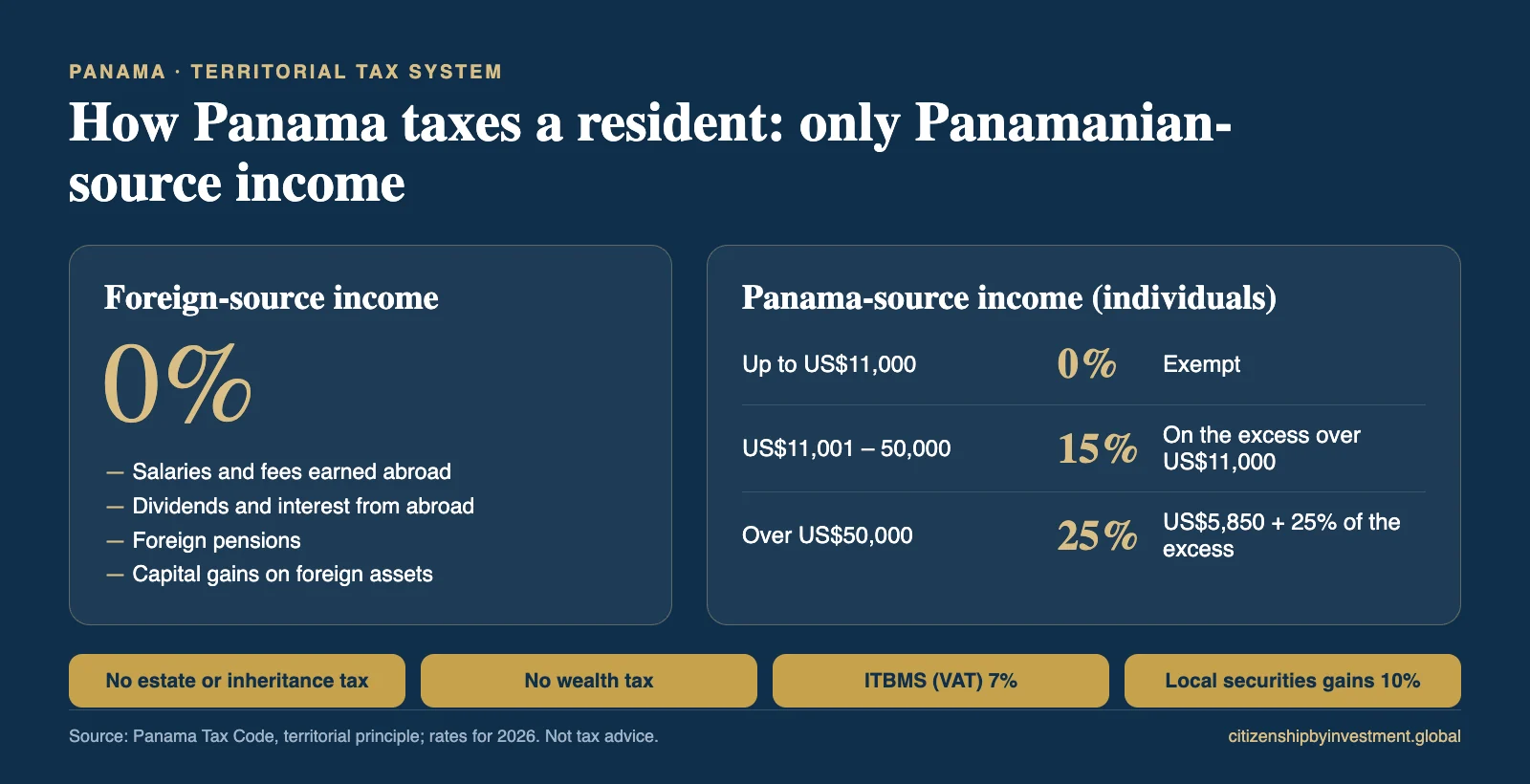
Panamanian tax law is built on the principle of territoriality. The United States taxes its citizens on worldwide income, and Canada and most of Western Europe tax residents on worldwide income. Panama does neither. Under the Panamanian Tax Code, liability depends on the source of the income, not on your residence status or passport.
- Foreign-source income (0% in Panama): dividends from foreign companies, gains on property abroad, returns on a foreign investment portfolio, fees for work performed outside Panama and foreign pensions are outside the Panamanian income tax.
- Panama-source income (taxed at progressive rates): income from business carried on in Panama, local employment, professional services performed in Panama and rent from Panamanian real estate.
In practice, an investor can hold permanent residence and a Panamanian cédula, own a home in Panama City and owe no Panamanian income tax on a foreign business or portfolio. Our short answer to whether you pay tax on foreign income as a Panama resident covers the common cases.
Personal income tax brackets in Panama
Where income does arise in Panama, the personal income tax schedule is short and predictable:
| Panama-source annual income (USD) | Rate | How it applies |
|---|---|---|
| Up to US$11,000 | 0% | Exempt |
| US$11,001 to US$50,000 | 15% | On the amount above US$11,000 |
| Over US$50,000 | 25% | US$5,850 plus 25% of the amount above US$50,000 |
Foreign-source income is not added to local income to push it into a higher bracket. If all of your income arises abroad, you have no Panamanian personal income tax to pay on it.
Estate, wealth, gift and capital gains taxes
Taxes on transfers and on wealth itself often cost families more than income tax over a generation. Panama's position is simple:
- No estate or inheritance tax: Panama levies no inheritance, estate or succession tax on personal assets.
- No wealth tax: there is no annual tax on net worth.
- No gift tax on foreign assets: gifts of assets located abroad are outside the Panamanian tax net.
- Capital gains: gains on foreign assets are not taxed in Panama. Gains on Panamanian securities or shares are taxed at a flat 10%. On the sale of Panamanian real estate, the gain is taxed at 10%, collected through a 3% advance payment on the higher of the sale price and the cadastral value; private sellers can usually treat the 3% as the final tax.
Corporate tax, Law 526 and special regimes
The standard corporate income tax rate is a flat 25% on net taxable income from Panama. Companies that run international business from Panama, such as trading between third countries or managing foreign operations from an office in Panama City, are generally not taxed on that foreign-source income.
There is one important change for corporate structures. Law 526 of 2026 and Executive Decree 32 of 2 September 2026 add an economic substance test for Panamanian entities that belong to a multinational group and receive foreign passive income (dividends, interest, royalties or foreign real estate income). From fiscal year 2027 such an entity keeps the territorial exemption only if it shows real substance in Panama, such as staff, premises, operating costs and board decisions taken locally; otherwise that income is taxed at 15%. The rule targets companies, not individual residents, but holding companies used by families should be reviewed before 2027.
SEM and EMMA regimes
- SEM (headquarters of multinational companies): a 5% corporate rate on qualifying services, customs benefits and fast-track permits for executives.
- EMMA (manufacturing and related services): comparable reductions for qualifying manufacturing and logistics operations.
Consumption tax and property tax
- ITBMS (value-added tax): the standard rate of the Impuesto de Transferencia de Bienes Muebles y Servicios is 7%, one of the lowest in the Americas. Alcohol (10%) and tobacco (15%) carry higher rates; basic food and medicine are exempt.
- Primary residence (Patrimonio Familiar Tributario): no tax on the first US$120,000 of value, 0.5% a year from US$120,000 to US$700,000 and 0.7% above US$700,000.
- Other property: second homes, rental and commercial property are taxed at up to 1% a year under Law 66 of 2017 (no tax on the first US$30,000, then 0.6%, 0.8% and 1% in bands). Many new residential buildings also carry a property tax exemption on the value of the construction for a number of years.
Residence: the first step to Panama's tax position
The territorial system applies to anyone, but becoming tax resident starts with a legal right to live in Panama. Three routes suit most of our clients.
1. Qualified Investor Visa
Often called the Panama golden visa, the Panama Qualified Investor Visa grants permanent residence directly. Since Executive Decree No. 17 took effect on 16 September 2026, the minimum is US$300,000 in new or pre-construction real estate, US$500,000 in resale property, securities or a deposit with Banco Nacional or Caja de Ahorros, or US$750,000 on deposit with a private bank, each held for five years. One visit every two years keeps the status.
2. Friendly Nations Visa
Citizens of designated countries, including the United States and Canada, can obtain residence through a qualifying real estate purchase of about US$200,000 or through employment in Panama. It starts with a two-year provisional permit before permanent residence.
3. Pensionado (retiree) visa
Retirees with a lifetime pension of at least US$1,000 a month qualify, and a lower figure has been accepted for applicants who also buy property worth US$100,000 or more. Pensionados receive discounts on travel, utilities and medical services. Confirm the current amounts before applying.
Eligibility and documents for each route are set out in our guide to Panama residency requirements, and our article on the Panama golden visa for high-net-worth investors covers how the investment itself is structured.
Cross-border compliance: what Panama residence does not change
Panama will not tax your foreign income, but your home country may, unless you have properly left its tax system.
- Canadian residents: to stop being taxed in Canada you must sever residential ties. Leaving triggers the departure tax, a deemed disposition of most assets at fair market value, which should be planned before you move.
- US citizens: the United States taxes citizens on worldwide income wherever they live, and there is no US–Panama income tax treaty. Living in Panama can make you eligible for the Foreign Earned Income Exclusion under the bona fide residence or physical presence test, and for foreign tax credits, but US filing continues.
- Transparency: Panama exchanges financial account information under the Common Reporting Standard (CRS) and has a FATCA agreement with the United States. It left the FATF grey list in 2023, and on 9 October 2026 the EU moved Panama from its list of non-cooperative tax jurisdictions to the watch list (Annex II).
For a wider comparison of low-tax residences, see our overview of tax haven countries.
Planning your Panama move
Permanent residence within weeks, a US dollar economy, modern banking and a territorial tax system make Panama one of the most practical second residences for US and Canadian families. The benefits depend on getting the sequence right: the residence route, the property or investment, your home-country exit and any company structures.
Our licensed team at Fast Passport Boutique by Jane Katkova coordinates the residence application with Panamanian counsel and your home-country tax adviser. Book a consultation to review how Panama's tax system would apply to your income and family, or compare it with other residence by investment programmes.
Written by the Fast Passport Boutique team and reviewed by Jane Katkova, Founder & Licensed CICC Consultant.