 Reviewed by Jane Katkova, Founder & Licensed CICC Consultant
Table of contents9 sections
- Panama Golden Visa for High-Net-Worth Investors: Structuring, Tax and the Path to Citizenship
- Why investors choose Panama: permanent status from day one
- Qualifying investments under Executive Decree No. 17
- Government fees and total cost
- Panama's territorial tax system in brief
- Cross-border structuring and compliance
- From permanent residence to Panamanian citizenship
- How to proceed
- Apply for Panama's Qualified Investor Visa with Fast Passport Boutique
For internationally mobile entrepreneurs and high-net-worth families, security is no longer only a question of portfolio diversification. It is also about jurisdictional options: a second residence that protects wealth, broadens mobility and separates where you live from where you are taxed.
The Panama Qualified Investor Visa, widely known as the Panama golden visa, is one of the fastest routes to permanent residence in the Americas. It now operates under Executive Decree No. 17 of 2026, which replaced Executive Decree No. 722 of 2020 and its amendments on 16 September 2026. This article looks at the programme from an investor's point of view: how to structure the investment, what it costs, how it interacts with your home-country tax position and how it leads to citizenship.
Why investors choose Panama: permanent status from day one
Most European programmes start with a temporary permit that must be renewed for years before permanent residence. Panama's Qualified Investor route grants permanent residence on approval.
- Permanent from the start: the investor and family skip the temporary stage and receive a resident cédula (E-Cédula).
- Minimal stay: one visit of any length every two years keeps the status.
- Fast processing: about 15 business days for the investment certificate and about 30 business days for the decision of the Servicio Nacional de Migración. Our answer on how long Panama permanent residency takes sets out the full timeline.
- Family included: a spouse, children under 18 and full-time students up to age 25 can be included in the same application.
Qualifying investments under Executive Decree No. 17
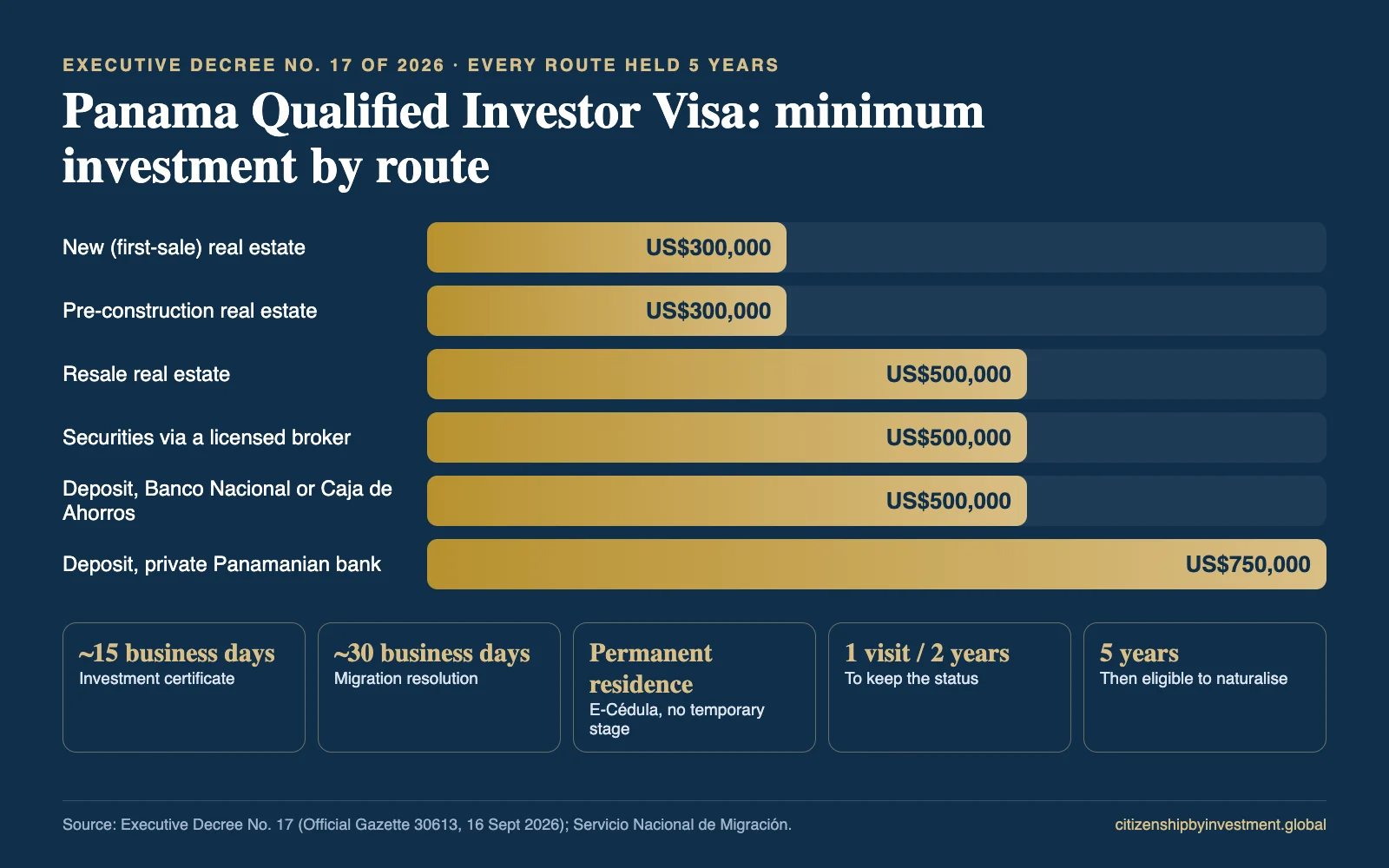
Decree 17 split the real estate threshold. New or first-sale property still qualifies from US$300,000; property that has been sold, occupied or rented before now needs US$500,000.
| Route | Minimum investment | Holding period | Key conditions |
|---|---|---|---|
| New (first-sale) real estate | US$300,000 | 5 years | Free of liens; held personally or through a Panamanian company or foundation you beneficially own |
| Pre-construction real estate | US$300,000 | 5 years | Funds held in trust or escrow with a licensed Panamanian bank, or full payment backed by a renewable bank guarantee; title required within three years |
| Resale real estate | US$500,000 | 5 years | Any property previously sold, occupied or rented |
| Securities | US$500,000 | 5 years | Through a broker licensed in Panama |
| Fixed-term deposit, state bank | US$500,000 | 5 years | Banco Nacional de Panamá or Caja de Ahorros |
| Fixed-term deposit, private bank | US$750,000 | 5 years | With a bank holding a general licence in Panama |
The investment must arrive by international transfer from an account in your own name, or from a company of which you are the ultimate beneficial owner, and it is confirmed each year to the Ministry of Commerce and Industries for five years. Investments and binding contracts completed before 16 September 2026 can still use the previous thresholds if the application is filed within six months, roughly by mid-March 2027. The full requirements are in our guide to residency requirements for Panama.
Government fees and total cost
Panama's government charges are fixed and modest. Legal fees, translations, apostilles and medical certificates come on top.
- Main applicant: US$5,000 in government fees plus a US$5,000 repatriation deposit.
- Each dependant: US$1,000 plus a US$1,000 repatriation deposit.
A family of four (two adults and two children) should budget about US$16,000 in government charges and deposits, in addition to the investment itself.
Panama's territorial tax system in brief
The main financial reason to hold Panamanian residence is the territorial tax system: Panama taxes only income earned in Panama. Foreign dividends, interest, capital gains, pensions and fees for work done abroad are not taxed there, while local income, such as rent from a Panamanian apartment, follows brackets of 0%, 15% and 25%. Brackets, property tax, capital gains and the new Law 526 substance rules for companies are covered in our guide to taxes in Panama.
Cross-border structuring and compliance
A Panamanian residence card does not exist in isolation. The tax benefit depends on how it fits with the rules of the country you are leaving.
1. Exit taxes and controlled foreign corporation rules
A residence card does not on its own end tax residence in countries that tax residents on worldwide income, such as Canada, the United Kingdom or Australia, and it changes nothing for US citizens, who are taxed on worldwide income wherever they live. Departure taxes, deemed disposition rules and controlled foreign corporation (CFC) rules should be reviewed before assets or companies are moved.
2. Tax treaties and the principal purpose test
Panama has about 17 income tax treaties, including with the United Kingdom, Singapore, France, Luxembourg, the Netherlands and the United Arab Emirates; there is no income tax treaty with the United States. Treaties updated through the OECD Multilateral Instrument include a principal purpose test, so structures need genuine commercial substance rather than paper companies. The same logic now applies inside Panama: under Law 526 of 2026, companies in a multinational group must show local substance from 2027 to keep foreign passive income exempt.
3. Transparency: CRS, FATCA and the EU lists
Panama exchanges information under the Common Reporting Standard and FATCA, and it left the FATF grey list in 2023. On 9 October 2026 the EU removed Panama from its list of non-cooperative tax jurisdictions (Annex I) and placed it on the watch list (Annex II) pending a Global Forum review. Clients based in the EU should still check how their own country treats payments to Panamanian entities.
From permanent residence to Panamanian citizenship
- Five years: Qualified Investor Visa holders who keep the investment and the biennial visits can apply to naturalise after five years of permanent residence. Nationals of Spain and some Latin American countries may qualify sooner under reciprocity.
- Requirements: applicants must speak Spanish and pass an exam on Panamanian history, geography and civics; the grant is discretionary and made by executive decree.
- Dual nationality: Panama's constitution asks naturalised citizens to renounce their previous nationality. The United States and Canada do not treat that declaration as a loss of citizenship, so in practice many naturalised Panamanians keep both passports.
Our guide to the path from Panama residency to a passport explains each stage.
How to proceed
- Choose the route before the property: confirm whether a property is first-sale or resale, because the threshold differs by US$200,000.
- Prepare the source-of-funds file early: transfer records, police certificates and apostilles take longer than the Panamanian processing itself.
- Align both sides of the border: pair Panamanian counsel with a tax adviser in your home country so that your exit, your companies and your new residence fit together.
Apply for Panama's Qualified Investor Visa with Fast Passport Boutique
Coordinating a Qualified Investor application, from choosing the investment route to filing with the Servicio Nacional de Migración, involves many moving parts. Our licensed team at Fast Passport Boutique by Jane Katkova manages the file with Panamanian counsel and helps you decide which investment route fits your family and tax position. Book a consultation, or review the programme details on our Panama residency by investment page.
Written by the Fast Passport Boutique team and reviewed by Jane Katkova, Founder & Licensed CICC Consultant.